How to Patch Test a New Skincare Product
A small-area check can reduce guesswork. It cannot guarantee future compatibility.
01
How to patch test skincare: the five-minute version
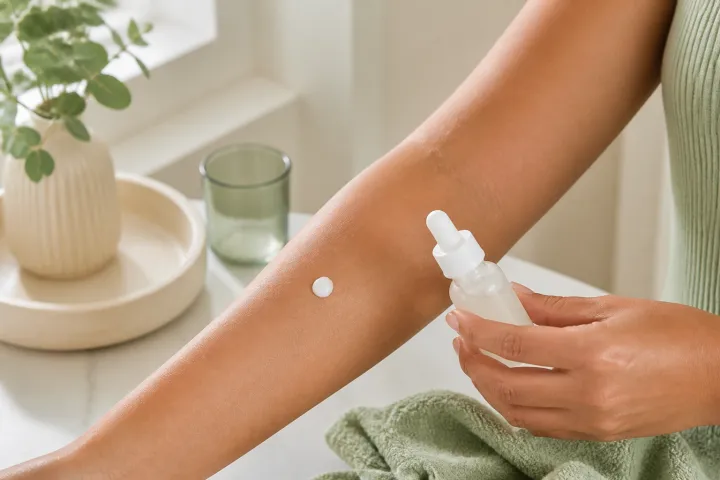
To patch test a new skincare product at home, apply the normal amount to a small, discreet area, the inside of the forearm or behind the ear are the common choices, following the product's own directions. Repeat daily for about a week while watching for redness, itching or stinging.
That is the whole technique. The rest of this guide is about doing it so that it actually produces information, and knowing the limits of what a quiet result proves.
It follows what the American Academy of Dermatology recommends for testing a new skin care product at home. A quarter-sized test spot, twice daily for seven to ten days, using the normal amount, somewhere it will not be rubbed or washed off. Our once-daily week is the relaxed version. If you want the by-the-book check, use the AAD cadence.
Why bother. Returns cost money, reactions cost weeks of calm skin, and the check costs a few minutes across days you were living anyway. After a few deliberate checks you also learn how your own skin announces disagreement, quickly or slowly, loudly or subtly, which makes every future introduction better calibrated.
02
What the AAD's home patch test actually involves
The American Academy of Dermatology's public guidance for testing a new product at home is specific. Apply it to a quarter-sized spot on the underside of your arm or the bend of your elbow, twice a day, for seven to ten days. Stop if the skin turns red, itchy, or swollen, and wash the product off right away.
A quick 24 to 48 hour check only shows an immediate irritant reaction, the kind that shows up within a day of one application. The AAD's longer twice-daily run is built to catch slower reactions, the kind that need several exposures to build up. A quick check can be enough for a rinse-off cleanser or a product from a line your skin already tolerates. Save the full seven to ten day run for retinol, exfoliating acids, new fragrance, or anything you plan to leave on your face daily.
03
Treat it as a small-area product check
Leave a rinse-off product on only for the time its label states. A leave-on product stays on as it normally would. Use the real amount you would use on your face, because a microscopic dab tests nothing.
This is a cautious home check, not the diagnostic patch testing a clinician performs with standardised allergens. A quiet result on one area does not prove a product can never cause a reaction somewhere else.
Keep the variables boring while it runs. Same area, same time of day, no new detergents or sunscreens on that patch of skin. If something changes, the new product should be the only candidate. Pick a stable week for it, not the week you also switch detergents, start a new sport, or fly somewhere with different air.
If you take prescribed skin treatments of any kind, your prescriber's guidance on introducing cosmetics alongside them outranks this guide. Bring the question to them rather than improvising a schedule.
04
Pick the right spot, and test one formula at a time
The inner forearm is convenient and discreet, though facial skin can behave differently. For leave-on facial products, a small area near the jaw or behind the ear gets closer to real conditions while staying easy to watch.
For products with a reputation for feel, a retinol or an exfoliating acid, starting behind the ear before committing the whole face is cheap insurance. Behind the ear has a practical bonus. It behaves like facial skin and stays invisible in meetings, which removes the social pressure to abort the test early.
Whichever site you choose, use the same one every time. A consistent location makes results comparable across products, which is quietly the most useful part of the habit.
Then keep the rest of the routine still. If cleanser, serum and moisturiser all change together, you cannot tell which formula changed how your skin feels. Pay attention to the whole product and its directions rather than assuming a familiar headline ingredient guarantees comfort, because fragrance components, preservatives and the base all matter.
This is the rule most often broken on haul day. Three new products go into a queue, not onto your face together. The queue costs three weeks and can save three months of guessing, and it forces a ranking. Testing the one you most wanted first puts the delay on the ones you wanted least, which has more than once answered whether they were wanted at all.
05
Reading the result honestly
Mild, brief tingling with some products can be unremarkable. Stinging that persists, spreading redness, itching or small bumps are a stop signal. When in doubt the conservative reading, stop and wait and retry once later if things stay calm, costs you a week rather than a face.
A pass is permission to proceed carefully, not a guarantee. Bring the product into the full routine slowly and keep watching through the first weeks.
Photograph the test area at the same time each day. It sounds obsessive and takes ten seconds, and comparing day one with day six answers "is this redder or am I imagining it" with something better than memory.
Learn the difference between a product that stings on application and settles within a minute, and an area still unhappy an hour later. Acids in particular announce themselves briefly. Persistence is the signal that matters.
06
A realistic schedule, and where extra patience pays
Days one to three. Apply the normal amount to the chosen area once daily, at the time you would actually use it. Nothing to see is a good result. Patch testing is boring by design.
Days four to seven. If the area stays calm, extend to a slightly larger area, or begin cautious normal use for leave-on products while watching the first full-face applications the way you watched the patch. On the stricter AAD cadence, keep the twice-daily applications going for the full seven to ten days before committing your whole face.
At any point, stinging that builds, spreading redness, itching or bumps ends the trial. Wait for calm skin before testing anything else, and do not re-test the same product on the same irritated spot to confirm. One clear answer is enough. Keep the product either way, because a returned or binned bottle cannot be identified later, and the packaging, batch number and ingredient list are exactly what a professional will ask for.
Scale the caution to the exposure. Leave-on products with actives, retinol, exfoliating acids, strong fragrances, earn a longer and more deliberate check than a rinse-off cleanser, and so does anything you plan to use daily on your whole face. Judging a two-minute rinse-off cleanser by a week of forearm testing is overkill.
Fragrance deserves its own mention. It is among the more common cosmetic sensitisers, it appears under many names, and unscented does not always mean fragrance-free. If you already know fragrance is your trigger, screen for it on the label before the patch test.
07
Know when a home check is not enough
Stop using the product if a reaction develops, and avoid testing the same irritated area again. Sudden swelling, difficulty breathing, eye involvement or blistering needs prompt professional care rather than skincare troubleshooting.
If several products cause recurring problems, or the trigger is unclear, keep the packaging and ingredient lists and speak with a qualified health professional. That record makes the assessment far more useful, and it helps you too. After a few reactions with the packaging kept, patterns show up, a shared preservative or a fragrance family, that no single incident could reveal.
Patch testing matters most for the ingredients the literature itself flags as demanding. Retinoid reviews openly describe an adjustment period of dryness and visible flaking, and exfoliating acids carry the same caveat. When the research says to expect your skin to object at first, a small-area trial is taking the papers at their word.
Questions, answered plainly
Before you add another step.
Does an at-home check prove a product is safe for me?
No — it lowers the odds of a surprise, nothing more. Skin can respond differently by area and over time.
Should I test several new products together?
One at a time. Multiple simultaneous changes make any reaction impossible to attribute.
Is this the same as a dermatologist's patch test?
No. Clinical patch testing uses standardised allergens under controlled conditions; the home version is a rough screening habit.
How long should I patch test before using a product fully?
Around a week of daily small-area use suits most leave-on products; the American Academy of Dermatology suggests seven to 10 days of twice-daily application. Scale it down for rinse-off formulas and up for strong actives.
What does the American Academy of Dermatology say about patch testing a new skin care product?
Apply it to a quarter-sized spot on the underside of your arm or the bend of your elbow, twice a day, for seven to 10 days. Stop and wash it off if the area turns red, itchy, or swollen.
Sources
References checked for this field note.
- American Academy of Dermatology — how to test skincare products ↗
- US FDA — allergens in cosmetics and label precautions ↗
- PubMed — review of cosmetic retinoid use in photoaged skin ↗
Sources support the general editorial context; they do not establish that every product or routine suits every person.