Dishwater Hands: What the Sink Does, and What Actually Helps
The detergent is the part that matters. The answer is a habit, not another product.
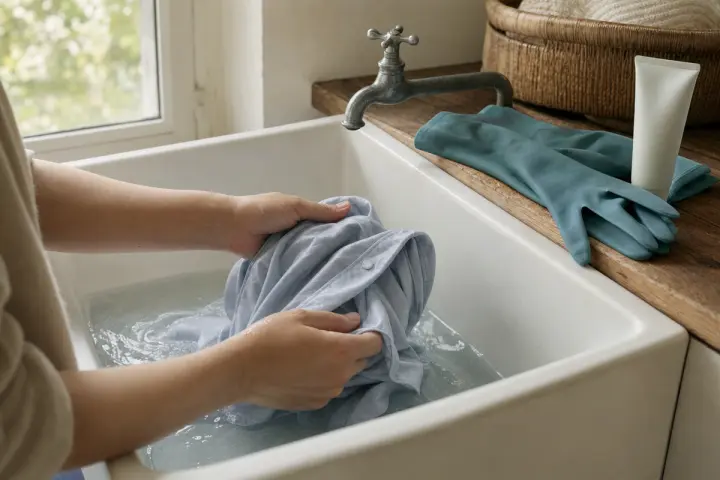
01
Hand skincare for washing up: the short version
Wash in lukewarm water rather than hot, keep your hands out of neat detergent for the long jobs by wearing gloves, dry to slightly damp instead of bone dry, and put a fragrance-free cream on straight away. That is the entire routine, and it takes about ten seconds a wash.
The rest of this note is about why the detergent rather than the water is the variable worth attacking, why hands report the damage a fortnight late, and where gloves help and where they quietly work against you.
It is worth naming the shape of the problem early: this is a small routine that has to happen often, not an elaborate one that happens occasionally. Frequency does more here than formulation ever will.
And the honest limit. The Cochrane review of workplace skin-protection strategies found the trial evidence low to very low in certainty — moisturisers, alone or with barrier creams, pointed towards a protective effect without reaching statistical significance. The direction is encouraging; the proof is thinner than the confidence with which it is usually repeated.
02
It is mostly the detergent, not the water
A 1992 use test put numbers on the washing-up problem. Eighteen healthy volunteers soaked their hands in a 0.05% solution of a commercial dish-washing product three times a day, fifteen minutes each time, for three weeks. One hand went in unprotected; the other wore a rubber glove.
Within the first two weeks, transepidermal water loss — the standard laboratory measure of how leaky the outer skin has become — rose more than 25% above baseline on the exposed hands of 13 of the 18 volunteers. Scaling, redness, fissures, itching and dryness followed, and almost exclusively in the people whose readings had moved.
The control arm is the part worth remembering. The three volunteers who had reacted most strongly repeated the whole protocol with warm tap water alone. No significant change in their readings, and no symptoms. At washing-up temperature, the surfactant was doing the work.
That is a small, old study of one product at one concentration, so treat it as a demonstration rather than a dose chart. But it points the effort in a useful direction: the ingredient you can most easily keep off your skin is the one that matters most.
03
Temperature is the lever that costs nothing
Water is not innocent either. A 2022 study of fifty healthy volunteers measured skin before and after ten-minute immersions and found water loss and pH rose after both hot and cold exposure — but hot water, at around 41°C, roughly doubled water loss from baseline and raised redness with it. Cold water moved the same measures far less.
The authors' recommendation was plain: use cold or lukewarm water for hand washing and avoid hot. Dermatology bodies have said the same for years; this study is the measurement behind the advice.
Most people wash up hotter than the job requires, partly because heat is what makes detergent feel like it is working. Turning the tap down is free, requires no product, and is the single change most likely to survive a busy week.
Keep the finding in proportion. These were immediate measurements on healthy skin after a single immersion, not evidence that one hot wash does lasting harm. It is a reason to prefer the setting that measures gentler when you are at the sink three times a day.
04
Wet work has a threshold, and an ordinary day can meet it
Occupational medicine has a working definition of wet work: hands immersed in liquids for more than two hours per shift, or waterproof gloves worn for the equivalent stretch, or more than twenty hand washes per shift. Cross any one of those lines and the risk of irritant hand dermatitis climbs.
The definition was written for kitchens, hospitals, salons and cleaning work. But a day that includes laundry washed by hand, two rounds of washing up, bathing a child and ordinary hygiene meets that bar comfortably, without anyone calling it work.
The number is not there to label you. It is there to make you add up a total you have never added up, because the exposure arrives in small pieces spread across a day and almost everyone underestimates it.
So count one ordinary day honestly. If you are near the threshold, the first move is fewer and shorter exposures — a full sink instead of six rinses, a dishwasher load instead of a scrub, gloves for the laundry — and cream second. Reducing the exposure is worth more than upgrading the cream.
05
The damage reports about a fortnight late
The other finding in that 1992 study is the one that changes behaviour. The visible and felt signs peaked one to two weeks after the water-loss readings did. The barrier moved first; the hands announced it later.
Which means today's hands are a report on the fortnight behind you, not on this morning. "My hands are fine" is a statement about a period you can no longer edit, and it is the reason the habit keeps getting dropped in exactly the week it is working.
Practically: judge any change at two to three weeks, not two days, and hold the routine through the good weeks rather than treating them as permission to stop. Recovery runs on the same lag as the damage.
The delay also explains a common misattribution. A new cream that seems to have "caused" roughness has usually arrived after the damage was already banked — it is the first thing standing there when the bill comes due.
06
Damp skin, then cream: the ten seconds that matter
The American Academy of Dermatology's version is specific enough to follow without interpretation. Wash for at least twenty seconds in lukewarm water, pat dry but leave the hands slightly damp, then apply cream or ointment to that damp skin, working some into the fingertips and around the nails.
Damp is the operative word. You are giving the product water to hold rather than asking it to conjure some, which is why the same cream on bone-dry hands feels like it does less.
Format is doing more work than the marketing suggests. A cream or ointment from a tube or tub beats a thin lotion from a pump, and fragrance-free and dye-free are the sensible defaults on skin you are asking to tolerate repeated washing.
As for what is in it, the AAD names three jobs rather than a hero ingredient: humectants to hold water, such as glycerin or hyaluronic acid; lipids such as ceramides to put back some of what the surfactant removed; and occlusives such as mineral oil or petrolatum to slow the loss. Panthenol is a common and well-tolerated companion in this category. A formula that covers all three jobs is worth more than one that shouts about any single one.
The usual failure is placement, not chemistry. A cream that lives at the sink and beside the laundry gets used twelve times a day; the better cream in the bathroom cupboard gets used twice. Buy two of the cheaper one. Hand sanitiser follows the same rule — let it dry, then cream.
07
Gloves earn their place, with one caveat
In the 1992 study the gloved hand was the protected one, and that remains the strongest single argument for gloves at the sink. For a full washing-up session or a load of hand-washed laundry, they do more than any cream can.
The caveat is in the wet-work definition itself: waterproof gloves worn long enough count as wet work in their own right. Sweat trapped against skin inside an occlusive glove is still occlusion, and the hand comes out damp, softened and easier to irritate.
So use them for the long jobs rather than as an all-day habit. Keep sessions reasonably short, turn them inside out to dry between uses, and wear a thin cotton liner if you will be in them for a while — the standard occupational advice for stretches beyond about ten minutes.
One rule has no exceptions: a glove with a hole is worse than no glove at all. It holds detergent solution against the skin for the length of the job. Bin it rather than finishing the washing up in it.
08
What to leave out, and when to stop guessing
You do not need a hand serum, a hand mask, an overnight treatment and a day cream. One cream that covers humectant, lipid and occlusive, used often, plus gloves for the long jobs, is the whole answer. This is a category where the shopping is much easier than the habit.
Dish soap sold as moisturising is still a surfactant designed to lift fat off plates. Treat the claim as a tiebreaker between two bottles you were already choosing between, not as a substitute for gloves or cream.
Skip exfoliating acids on hands that feel rough from washing. Rough here is usually a barrier short of lipids and water rather than a surface that needs sanding, and the acid tends to arrive as one more thing for an already-taxed barrier to absorb.
The one addition genuinely worth making is sunscreen on the backs of the hands, for an unrelated reason: they are exposed most days and covered almost never. The AAD asks for broad-spectrum, water-resistant, SPF 30 or above.
And the boundary. Skin that cracks, bleeds, weeps, itches persistently, hurts, or spreads beyond the hands has moved past what a cosmetic routine is for — take it to a qualified health professional, and treat it as a workplace conversation too if it is happening at your job. Skiniko's part of this is how hands look and feel. That is a real question, and it stops well short of the rest.
Questions, answered plainly
Before you add another step.
Is it the hot water or the dish soap that dries my hands?
Both measure badly, but the detergent is the bigger lever. In the dish-washing use test, warm tap water alone on the same schedule produced no significant change, while the detergent solution did.
Does dish soap labelled moisturising protect my hands?
It is still a surfactant chosen to strip fat off plates. Treat the claim as a tiebreaker between two bottles, not as a reason to skip gloves or the cream afterwards.
Are rubber gloves enough on their own?
For long jobs they do the most of anything. But a waterproof glove worn for hours is its own damp environment: keep sessions short, dry them between uses, and bin any glove with a hole.
How long before my hands feel better?
Judge it at two to three weeks. In the use test, symptoms peaked one to two weeks after the barrier readings moved, so both damage and recovery run behind what you can feel today.
Sources
References checked for this field note.
- American Academy of Dermatology — dry skin relief from handwashing ↗
- American Academy of Dermatology — four skin care tips for your hands ↗
- PubMed — use test of daily dish-washing with synthetic detergent on human skin ↗
- PubMed — review defining wet-work exposure as a risk factor for hand dermatitis ↗
- PubMed — Cochrane review of interventions for preventing occupational irritant hand dermatitis ↗
- PubMed — study of water exposure and temperature on skin barrier function ↗
Sources support the general editorial context; they do not establish that every product or routine suits every person.