Midday Shine: Why Your Face Looks Shiny by Lunchtime
The mirror shows surface shine. It does not tell you which layer produced it.
01
Three different shines that look the same
By midday, the gloss on your face can be facial oil, sweat, or the film left by moisturiser, sunscreen and makeup. Usually some blend of all three. They look identical in a mirror and have different fixes, which is why guessing buys so many wrong products.
Research on facial sebum shows it varies by area of the face, so a glossy nose does not describe your cheeks. A whole-face verdict from a T-zone observation overshoots.
The blend shifts through the day. Gloss at 10am after a commute is mostly sweat and film. The 3pm version in air-conditioning is more likely oil. Noticing when shine appears is half the identification. Climate multiplies all three, because in humid heat sweat arrives faster, product films soften, and oil spreads more readily. The same routine can produce a matte morning indoors and a glossy one outside.
02
Separate visible shine from a skin-type label
Shine by midday does not automatically make you oily skinned, and the label matters less than the observation. Heat, humidity, activity and the morning product stack all change what you see by lunch. Treat it as a prompt to test the routine, not as a diagnosis or a reason to replace every product.
The label matters commercially too. Oily skin is a marketing segment as much as a description, and products sold against it run from sensible light textures to outright strip-mining. The observation, shine and where and when, buys better products than the identity does.
Shine is also not a defect to be eliminated at any cost. Comfortable skin has some gloss, and the fully matte face is mostly a photography convention. The target is not annoying to you, not matte at all hours. If your complaint travels with visible blemishes rather than gloss alone, read the blemish-prone concern guide alongside this one. The two questions overlap in products but not in reasoning.
03
Work out which layer is producing it
Here is a cheap experiment. On a free morning, apply your routine one layer at a time with ten-minute gaps, checking the mirror between layers. The step after which the gloss appears is your lead suspect, and often it is simply too much of a product rather than the product itself.
Sweat-driven shine gives itself away. It arrives with heat and activity regardless of what you applied, which points at blotting and climate management rather than a new serum.
Repeat the layer experiment once on a weekend and you have data about your own routine that most people never collect. It costs one slow morning and usually retires at least one product.
If the suspect turns out to be sunscreen, do not solve shine by thinning the application below its labelled amount. That trades a cosmetic annoyance for less of the protection you are applying it for. Change the format instead. The market is full of fluids and gels made for exactly this complaint.
Then run the smallest useful routine test. Keep sunscreen in place, remove one optional layer for several mornings, and start with the step whose job is already covered elsewhere. Let layers settle, use the amount each label directs, and remember that changing texture is different from abandoning moisturiser or sun protection. If removing a layer changes nothing, put it back if you miss it. The experiment is reversible by design.
04
Reducing shine during the day
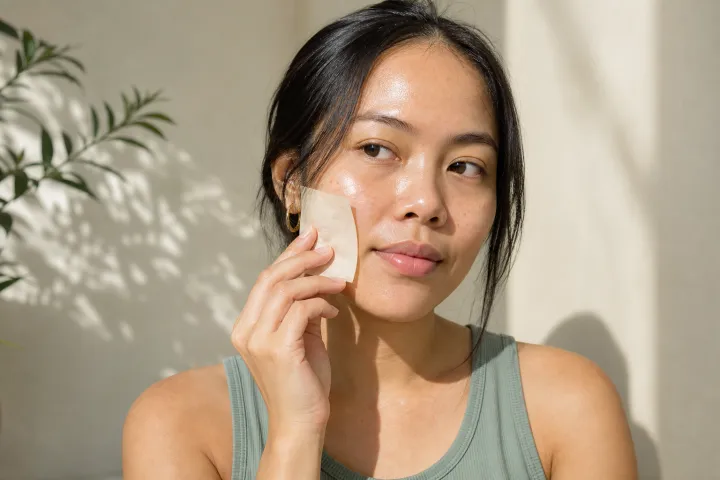
Blotting papers, or a clean tissue pressed rather than wiped, lift surface gloss in seconds without disturbing sunscreen. That is the entire job description, and for many people it closes the complaint.
Powder over sunscreen is the next step for makeup wearers. Washing your face at lunch is rarely the answer, because it removes sun protection you then have to reapply, and it trains a strip-and-compensate cycle.
Blot before the shine annoys you rather than after it has mixed with a fresh sunscreen reapplication. A mid-morning and an early-afternoon press keeps the surface tidy with two gestures a day. Build the kit once, with a slim pack of blotting papers in the bag you actually carry. The fix only works when it is within reach at the moment of annoyance, and a drawer at home does not help at a 2pm meeting.
05
Longer-term edits with a cosmetic case
A niacinamide step has a reasonable cosmetic case for the look of shine and tone over weeks of consistent use. One product, as directed, judged after a fair trial.
Gel and fluid textures in moisturiser and sunscreen cut the film contribution immediately. This is the highest-value swap for anyone whose layer experiment pointed at product rather than oil.
Set expectations honestly on the niacinamide step. The cosmetic research looks at the appearance of shine and tone over weeks, not days, and the effects are modest. It is a lever, not a switch. Give it several weeks, used as directed, judged against the notes you kept rather than against the mood you are in.
06
Do not turn shine into an exfoliation contest
Repeated washing, abrasive scrubs and several leave-on acids trade visible shine for tightness and irritation. If an exfoliating step has a clear job, use one formula as directed and assess it before adding another. Stripped skin does not photograph matte anyway. It photographs tight and flaky.
The overwashing spiral deserves its own warning. Stripped skin often looks shinier within hours, which convinces people to wash harder. If your cleansing count has crept past two proper washes a day, walk it back before you judge anything else. Clay masks and deep-cleansing products belong in the same budget. Occasional use for the feel of it is fine, and a daily mattifying ritual stacks with cleansing into the same loop.
Sudden changes in how oily skin looks or feels, shine that arrives with persistent blemishes and discomfort, or reactions to every attempted edit are beyond a routine tweak's pay grade. Anything sudden or persistent with pain, rash or significant irritation belongs with a qualified health professional, and bringing the product list shortens the conversation. Say what changed, roughly when it started, and what you use. Three facts and a list.
One thing worth knowing before you shop. The evidence for cosmetic actives against visible shine is thinner than for almost any other concern on this site. Dermatologist consensus does recommend niacinamide for oily-looking skin, and meta-analyses cover salicylic acid in blemish contexts, but sebum reduction from a serum is modest and gradual. That is exactly why habits and texture choices carry most of this article.
Questions, answered plainly
Before you add another step.
Does a shiny face by midday mean I should skip moisturiser?
Not automatically. First test fewer overlapping layers or a lighter texture while keeping the routine comfortable.
Should I wash my face again at lunchtime?
Usually the smallest test is to blot surface shine and review the morning layers before adding another full cleanse.
Will salicylic acid remove all facial shine?
No ingredient guarantees that result. A salicylic-acid step is optional and should not be stacked with several other exfoliants.
Are blotting papers bad for skin?
No — pressed gently, they lift surface gloss without disturbing sunscreen, which makes them the lowest-risk fix available.
Sources
References checked for this field note.
- PMC — study of facial sebum measurement and variation by facial area ↗
- PMC — cross-sectional study of environment and facial skin measurements ↗
- PubMed — Delphi consensus study of dermatologist-recommended skincare ingredients ↗
- PubMed — meta-analysis of topical azelaic acid, salicylic acid, nicotinamide and related agents ↗
Sources support the general editorial context; they do not establish that every product or routine suits every person.